How Practice Records Changed from Marginal Notes to Training Logs
Learn how practice records moved from notes beside the task to formal training logs, and choose a simple format that supports your next session.
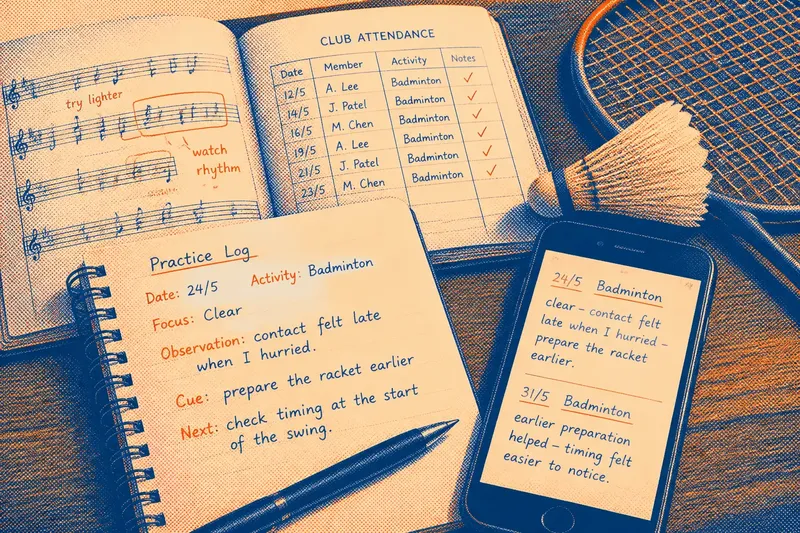
How did people keep track of practice before training logs became familiar? The answer depends on the activity: a musician could annotate a score, while a player might use a club record or personal notebook. These sources leave different kinds of traces, so the history is less a single story of tally marks than a shift in what people chose to preserve.
For recreational players, that distinction matters. A record can be a reminder of a technique, a note of attendance or a structured account for a coach; each serves a different purpose. Understanding those differences makes it easier to choose a form that fits the activity rather than copy a professional athlete’s system.
Practice records began close to the activity
Before standardised forms and digital apps, a player’s written record was often embedded in another object: a diary, a club ledger, a calendar or the pages of a manual. A musician could annotate a score to remember a fingering or mark a passage for another attempt. Such examples are forms of personal and institutional documentation, not evidence that every participant kept a regular practice record.
The surviving record also reflects who had the time, materials and reason to write things down. A club ledger might document participation for the organisation, while a private notebook could capture a learner’s own observations. Neither necessarily offers a complete account of how a person practised.
This is why broad claims about what “people used” can mislead. A mark beside a passage may show that someone identified a place to revisit, but it cannot tell us how often they played it or whether it improved. The record shows what its maker considered worth noting, not everything that happened.
Training logs made practice easier to compare
As organised coaching and training became more formal, records could serve more than memory. A log might bring together dates, activities, workload, observations and plans, making it easier for a participant or coach to look across sessions. Unlike a note in a score, a log presents practice as a sequence that can be reviewed.
That structure has advantages and limits. Entries can help a player recall the context for a session, but a neat sequence of dates does not automatically explain what a movement felt like or why a task was difficult. A log is a container; its usefulness depends on the information entered and the decisions it supports.
Modern tools extend that range. A paper diary allows free-form notes; a spreadsheet can organise recurring categories; an app may combine text with reminders or training plans. More features do not necessarily mean a better fit. The central question is whether the format makes the detail you need easy to record and retrieve.
Records can serve memory, coaching or comparison
It helps to distinguish three common purposes. A memory aid brings back a cue or task; a coaching record helps a player and coach discuss what happened; a comparison record makes patterns across sessions easier to review. One record may serve several purposes, but mixing them without a reason can make it harder to use.
- If you need to remember a movement cue, record the cue beside the activity; if it is already easy to recall, leave the entry out.
- If a coach needs context, include the drill and an observation; if the note is only for you, use shorthand you can understand later.
- If you want to compare sessions, keep the observation consistent; if the task changes, note the change rather than treating unlike sessions as directly comparable.
- If a tally makes attendance visible, use it for that purpose; if it starts to feel like a judgement of skill, stop tallying and write a relevant observation instead.
- If an app makes entries easier to retrieve, keep using it; if notifications or extra fields distract you, switch to a notebook or a plain phone note.
- If a record is taking attention away from practice, reduce its detail; if a particular question still needs an answer, keep only the entry that helps address it.
These choices are about the job of the record, not a universal standard. A club’s attendance sheet and a player’s private notes may look equally simple while answering entirely different questions.
A short entry can preserve a useful decision
Say you play recreational badminton and want to remember why your clears sometimes fall short. Imagine your starting point is a phone note with only the session date and the word “badminton”; it tells you when you played but not what to revisit. After practice, you add “clear — contact felt late when I hurried — prepare the racket earlier”. At the next session, you try that cue and note whether the timing felt easier to notice.
The result is not a score or proof of improvement. It is a trace linking a task, an observation and a possible next action. If the cue is useful, you can return to it; if it is not, the next note can record a different observation. This keeps the record tied to a practical decision rather than a demand to document everything.
Which practice record should you choose?
Is a training log the same as a diary?
A diary is usually open-ended, while a training log often uses recurring fields such as activity, session details and notes. The boundary is flexible: a notebook can function as either, depending on what you write and how you use it.
What should a recreational player record?
Start with the detail you are likely to need again, such as a technique cue, a recurring difficulty or a question for a coach. If you cannot see how an entry would affect a later choice, it may not need to be recorded.
Are digital practice apps better than paper?
Neither format is inherently better. An app can make searching and reminders convenient, while paper can keep notes beside a score or in a sports bag without extra setup; choose the one that suits your activity and attention.
Can a practice log show improvement?
A log can preserve observations that help you notice change, but it cannot establish the cause of that change by itself. Compare similar tasks and conditions where possible, and treat the entries as useful context rather than a definitive measure.
Use history as context, not a template
The movement from marginal notes and diaries towards structured logs reflects changing purposes and tools, not a single best method replacing all others. A note in a score may suit a musician; a notebook or phone app may suit a recreational player who wants to remember a cue. The main phrase, practice records, covers all these forms without implying they are interchangeable.
Before keeping a record, decide what future question it should help answer. If the answer is “where should I resume?” a brief cue may be enough; if a coach needs context, include the relevant drill and observation. That small choice makes the record more useful than adding fields simply because a form has room for them.